


When a tooth has a cosmetic concern, whether it is a chip, discolouration, an uneven edge, or a small gap, there are usually several ways to address it. Veneers, crowns, and dental bonding are three of the most common options people consider, and on the surface they can seem interchangeable. In practice, each works quite differently and suits different clinical situations.
Choosing between them is not simply a matter of preference or budget. The condition of the underlying tooth, the extent of the concern, and the amount of remaining natural tooth structure all play a role in determining which option a dentist may recommend. Cosmetic dental treatment always begins with a thorough assessment of the tooth and the patient’s overall oral health, which informs what is clinically appropriate.
Quick Overview
- Veneers, crowns, and dental bonding all address cosmetic concerns, but each is designed for different situations and involves a different level of tooth preparation
- Veneers may suit mostly healthy teeth where the concern is limited to the visible front surface; crowns may be recommended when a tooth has structural damage or significant decay; bonding may suit minor repairs with minimal tooth preparation
- How much existing tooth structure remains, and how extensive the concern is, are often the deciding factors between options
- Longevity, cost, reversibility, and ongoing care requirements differ significantly between each treatment, and individual outcomes vary
- A dental assessment is the appropriate starting point before any of these treatments
The sections below outline how each option works, when each is typically used, and what to consider before making a decision.
What Is Dental Bonding and When Is It Used?
Dental bonding is the most conservative of the three options. A tooth-coloured composite resin material is applied directly to the surface of the tooth, shaped by hand, and then set hard using a curing light. The process can usually be completed in a single visit and, in many cases, requires little or no removal of existing tooth enamel.
Bonding is commonly used to address small chips or cracks on the edge of a tooth, minor gaps between front teeth, slight discolouration that does not respond to whitening, uneven edges, and short or worn tooth edges. It is considered a largely reversible option in many situations, making it practical for patients who want to explore a change with a lower level of commitment.
The trade-off is durability. Composite resin is more porous than porcelain and can stain over time, particularly with regular consumption of coffee, red wine, or dark foods. The material can also chip under pressure. Composite resin placed as bonding can chip or fall out and may need replacing over time. Composite bonding typically lasts between three and seven years, depending on the location of the treated tooth, bite forces, and how well the patient cares for the restoration. Individual outcomes vary.
What Are Dental Veneers and When Are They Used?
Dental veneers are thin shells, typically made from porcelain or composite resin, that are fixed to a tooth’s front surface. They are used for cosmetic concerns on mostly healthy teeth where the issue is confined to the visible front surface and the underlying tooth structure is largely intact.
Veneers are a higher-risk cosmetic procedure under Australian guidelines. This means they should be discussed thoroughly with a dentist before proceeding, as suitability depends on individual clinical factors and the treatment is considered irreversible in most cases.
Porcelain Veneers
 Porcelain veneers are custom-made at a dental laboratory and require at least two appointments to place. At the first appointment, a thin layer of enamel is removed from the front surface of the tooth to allow the veneer to sit flush with the surrounding teeth. An impression or digital scan is taken and sent to the laboratory, and a temporary veneer is placed while the permanent one is being fabricated. At the second appointment, the porcelain veneer is bonded in place.
Porcelain is non-porous and more resistant to staining than composite resin. Porcelain veneers typically last 10 to 15 years with proper care, and in some cases longer, depending on the patient’s bite, oral hygiene, and habits. Because enamel is removed during preparation, porcelain veneers are considered a permanent commitment: the tooth will always need some form of coverage going forward. Individual outcomes vary.
Composite Resin Veneers
Composite resin veneers are applied directly to the tooth in a similar way to bonding but cover the entire front surface rather than just one section. They can often be placed in a single visit. Composite veneers tend to cost less than porcelain but require replacement sooner, typically within five to seven years. They are also more susceptible to staining over time than porcelain.
When Veneers May Not Be Appropriate
Veneers may not be suitable in all situations. Gum disease is a contraindication for veneers, as is significant decay or structural damage to the tooth beneath, or a habit of grinding or clenching the teeth. These factors are assessed at a dental consultation before any treatment proceeds. Suitability depends on individual clinical circumstances, and no outcome can be guaranteed.
What Are Dental Crowns and When Are They Used?
A dental crown is a cap that covers the entire visible surface of the tooth, from the gum line upward. Unlike a veneer, which adheres to the front of the tooth only, a crown wraps around the full tooth structure, restoring both its appearance and its function.
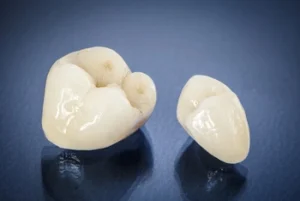 Crowns are typically recommended when a tooth has significant structural compromise, such as:
- Extensive decay that leaves too little healthy tooth structure for a filling or veneer
- A cracked or fractured tooth at risk of breaking further
- A tooth that has had root canal treatment and has become more brittle
- A heavily worn tooth that needs to be rebuilt in height and shape
- A tooth with a very large existing filling where the remaining tooth structure cannot adequately support the filling alone
Because a crown covers the full tooth, it requires more preparation than a veneer. The tooth is shaped and reduced on all sides to accommodate the crown. Like veneers, this is considered an irreversible procedure.
Crowns can be made from porcelain, zirconia, gold alloy, or a combination of porcelain and metal. The material chosen for a crown depends on the location of the tooth, the forces it will need to withstand, and cosmetic considerations. A crown can last for many years with appropriate care, though individual longevity depends on oral hygiene, bite load, and the specific material used.
Veneers vs Crowns vs Bonding: Key Differences
The three options are not interchangeable, and the right choice depends on the clinical situation of the individual tooth. As a general framework:
Dental bonding tends to suit situations where the cosmetic concern is minor, the tooth is otherwise healthy, and preserving maximum tooth structure is a priority. It is the least invasive option, often reversible, and can be completed in a single visit. It requires more frequent maintenance or replacement than the other two options.
Veneers tend to suit situations where the cosmetic concern affects the full front surface of the tooth, such as broader discolouration, multiple uneven teeth, or shape changes that bonding alone cannot achieve. The underlying tooth should be mostly intact and structurally sound. Porcelain veneers offer a longer-term option but require permanent enamel removal and should be approached as a considered decision, given they are classified as a higher-risk cosmetic procedure. Individual outcomes vary.
Crowns tend to suit situations where the tooth needs structural restoration in addition to cosmetic improvement. When a tooth has been significantly weakened by decay, fracture, or a large previous restoration, a veneer or bonding material cannot provide the protection the tooth requires. A crown addresses both the appearance and the structural function of the tooth.
A dentist will assess the condition of the tooth, the extent of the concern, and the patient’s overall oral health before recommending a course of treatment.
How Long Do These Treatments Last?
Longevity is one of the most commonly asked questions when comparing these options, and it is also one of the most variable. How long any restoration lasts depends on the material, the location of the tooth, the patient’s bite, oral hygiene, and habits such as grinding or clenching.
As a general guide: 
- Composite bonding: typically three to seven years, though this varies. Front teeth that do not bear heavy chewing forces tend to hold bonding longer than teeth further back.
- Composite veneers: typically five to seven years before replacement is needed.
- Porcelain veneers: typically 10 to 15 years, and in some cases longer, depending on individual factors.
- Dental crowns: can last for many years with appropriate care. Longevity depends on the material used, the tooth’s location, and how well the crown margin is maintained with daily cleaning.
None of these options lasts indefinitely. Individual outcomes vary between patients.
What Affects Which Option Is Recommended?
Several factors influence what a dentist may recommend for a particular tooth.
The condition of the tooth: If the tooth has significant structural damage, decay, or has had root canal treatment, a crown is often the more appropriate choice. If the tooth is mostly intact but has surface-level cosmetic concerns, veneers or bonding may be considered. If the concern is minor, bonding may address it without more invasive treatment.
The extent of enamel remaining: Veneers require a small amount of enamel removal from the front surface. If there is insufficient enamel, or if a tooth has previously had enamel removed for an earlier veneer, a crown may be the next step. Bonding typically requires little or no enamel removal.
Bite forces and grinding habits: Patients who grind or clench their teeth place higher forces on any restoration. This can shorten the lifespan of bonding and may affect suitability for veneers in some cases. A dentist will consider this during assessment and may discuss a nightguard alongside any cosmetic treatment.
The number of teeth involved: Both bonding and veneers can be applied to multiple teeth. For broader cosmetic changes involving several front teeth, porcelain veneers may offer a more consistent result, as porcelain can be colour-matched across multiple teeth more predictably than composite resin, which may shift in shade over time.
Overall oral health: Oral health before cosmetic treatment matters significantly. Active gum disease or untreated decay needs to be addressed before cosmetic treatment can be considered.
How to Care for Veneers, Crowns, and Bonded Teeth
All three treatments require consistent oral hygiene to perform well over time. The specific care approach varies slightly between options.
For bonded teeth and composite veneers: clean daily as you would natural teeth. Composite resin can stain with prolonged exposure to coffee, tea, and red wine, so rinsing with water after consuming these helps maintain the appearance of the material. Composite is also more susceptible to chipping than porcelain, so avoid using treated teeth to open packaging, bite nails, or chew on ice.
For porcelain veneers: brush and floss daily. Porcelain does not stain in the same way composite resin does, but the tooth underneath still requires careful cleaning. Avoid habits that could chip or crack the veneer. If you grind your teeth, discuss a nightguard with your dentist to protect the veneers from bite forces overnight.
For crowns: take particular care cleaning the gum line around the crown. Although the crown material itself cannot decay, the tooth underneath still can. Regular flossing around the crown margin helps prevent decay where the crown meets the natural tooth.
For all three: maintaining a consistent dental check-up routine is important. A dentist can monitor the condition of any restoration, identify early signs of wear or damage, and advise when care adjustments are needed before a larger problem develops. Regular visits also allow cleaning around the margins of crowns and bonded areas that are harder to clean at home.
A Considered Approach to Cosmetic Dental Treatment
 Veneers, crowns, and dental bonding each serve a different purpose, and none is universally the right choice for every tooth or every patient. The most suitable option depends on the condition of the individual tooth, the extent of the cosmetic concern, and what a clinical assessment reveals.
All three treatments carry some degree of risk, as is the case with any dental procedure. Veneers in particular are a higher-risk cosmetic procedure and should be approached as a considered decision made in consultation with a dentist, not as a routine or minor change. Individual outcomes vary, and no cosmetic result can be guaranteed.
If you would like to explore whether any of these cosmetic dental options may be appropriate for you, you are welcome to call Total Care Dental Studio on (07) 3186 8517 or book an appointment online.
Note: Any surgical or invasive procedure carries risks. Before proceeding, you should seek a second opinion from an appropriately qualified health practitioner.
Frequently Asked Questions
What is the difference between veneers, crowns, and dental bonding?
Veneers are thin shells bonded to the front surface of a mostly healthy tooth. Crowns cover the entire tooth and are used when the tooth has significant structural damage. Dental bonding applies composite resin to repair minor chips, gaps, or discolouration with little or no removal of tooth structure. Each is suited to different clinical situations, and a dentist will assess which is appropriate for an individual tooth.
Is dental bonding as durable as veneers?
Composite bonding generally does not last as long as porcelain veneers. Bonding typically needs attention or replacement within three to seven years, while porcelain veneers can last 10 to 15 years or more with proper care. Bonding can also stain more readily than porcelain. However, bonding is more conservative, often reversible, and may be appropriate when the cosmetic concern is minor. Individual outcomes vary depending on the tooth’s location, bite forces, and oral hygiene.
Do veneers damage your teeth?
Porcelain veneers require the removal of a thin layer of enamel from the front surface of the tooth. This is considered irreversible, meaning the tooth will always need some form of coverage going forward. The procedure should be discussed carefully with a dentist before proceeding. Veneers are a higher-risk cosmetic procedure, and suitability depends on individual circumstances including the amount of enamel present and the patient’s overall oral health.
When is a crown recommended instead of a veneer?
A crown is generally recommended when a tooth has significant structural compromise, such as extensive decay, a fracture, a very large filling, or when the tooth has had root canal treatment. A veneer only covers the front surface and cannot provide the same structural protection as a crown. If a tooth does not have enough healthy structure to support a veneer, a crown is often the more appropriate option. A dental assessment will clarify which applies to a specific tooth.
References
Healthdirect Australia. (2025). ‘Veneers’. Healthdirect Australia, February. Canberra, ACT: Australian Government. https://www.healthdirect.gov.au/veneers
Healthdirect Australia. (2025). ‘Dental crown procedure’. Healthdirect Australia, February. Canberra, ACT: Australian Government. https://www.healthdirect.gov.au/dental-crown-procedure
Australian Dental Association. (n.d.). ‘Crowns, bridges and veneers’. teeth.org.au. Sydney, NSW: Australian Dental Association. https://teeth.org.au/crowns-bridges-and-veneers
Australian Dental Association. (n.d.). ‘Gum disease’. teeth.org.au. Sydney, NSW: Australian Dental Association. https://teeth.org.au/gum-diseases
Better Health Channel. (2025). ‘Cosmetic dentistry and teeth whitening’. Better Health Channel, 12 December. Melbourne, VIC: Victorian State Government. https://www.betterhealth.vic.gov.au/health/conditionsandtreatments/cosmetic-dentistry-and-teeth-whitening
Better Health Channel. (2025). ‘Teeth and mouth care’. Better Health Channel, 25 July. Melbourne, VIC: Victorian State Government. https://www.betterhealth.vic.gov.au/health/conditionsandtreatments/teeth-and-mouth-care




When it comes to enhancing your smile, veneers are often the go-to choice for people seeking a stunning and long-lasting Read more